 Lehi, the first prophet in the Book of Mormon, was warned by the Lord that Jerusalem would soon be destroyed and was told to leave into the wilderness. While in the wilderness, Lehi had a peculiar dream.
In his dream, Lehi found himself in a dark and dreary wilderness. He saw a man in a white robe standing in front of him who told Lehi to follow him. Lehi was soon lost, however, and traveled alone for many hours. He was no doubt tired and afraid of not knowing where to go, so he prayed for comfort. No sooner had he prayed, when we saw that he was in a large and spacious field and he saw a tree whose fruit was desirable to make one happy. He saw that the tree and its fruit were whiter than anything he had seen before and the taste of the fruit was sweet and gave him great joy.
The joy and sweetness of the fruit gave him the desire to share with those he loved most: his family. As he looked around, he saw that a river ran by the tree. He soon saw his wife and youngest two sons, Nephi and Sam, far off, and that they too seemed to be lost. Lehi called to them and they came and also ate the fruit. Wanting his older two sons, Laman and Lemuel, to be there too, he looked farther up the river. When he saw them, he called out to them, but they would not come.
Alongside the river, an iron rod stretched from the tree off into the distance by where the river began. That large field now seemed to be as large as a world, and it was filled with countless people that were trying to get to the tree. A mist then covered the whole area so that the people could not see. This caused many to wander off and become lost but others held the iron rod in their hands and followed it until they reached the tree. There were some who made it to the tree but when when they ate the fruit, they looked around and were ashamed. Lehi looked for the cause of this shame and saw a large building that looked like it was floating in the air. The people in that building were all dressed in extravagant clothing and were pointing fingers and mocking those by the tree. Lehi watched and saw people get lost in the mist and others drown in the river; many followed the iron rod to the tree and the rest found their way to the large building to join the others in mocking and putting down those by the tree.
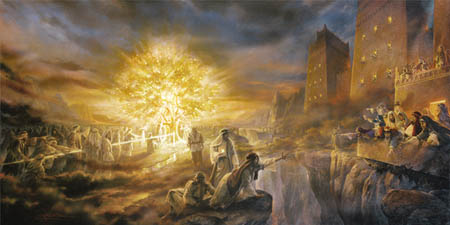
The meaning of this dream may not be immediately clear to everyone. It wasn’t to Lehi’s son, Nephi, but Nephi had enough faith that God would answer his prayers, so he took his questions to the Lord in prayer. In response to that prayer, Nephi also had a vision, where he saw the meaning of the dream and of Jesus Christ’s mission on earth and His love and gospel. He learned that the tree represents the love of God for us. The iron rod that led to the tree was the word of God, given through His prophets and that if we held onto those words, we would find the love of God and receive joy because of it. The people in the dream are each one of us, trying to find our way through the mists of temptations to reach God’s love. Many people fail to grasp the words of the Lord and get lost or drown in the filthy waters that represented that “awful hell that separates the wicked from the tree of life.” The large building that held those that opposed God represented the wisdom and pride of the world. Nephi saw its destruction and “the fall thereof was exceedingly great.”

The meaning of this dream applies to every person that has ever lived on this earth. Each of us is trying to get somewhere, even if we do not know where. What we seek is Christ and His love for us. By holding onto the iron rod, or rather, by reading scriptures and praying to God, everyone can receive Christ in their lives regardless of the obstacles.
Lehi’s dream can be found in 1 Nephi 8 and Nephi’s vision in 1 Nephi 11. Nephi sees much more than this and I invite everyone to read about it in chapters 12 – 14. In 1 Nephi 15, Nephi explains the meaning of the dream to his older brothers, Laman and Lemuel.
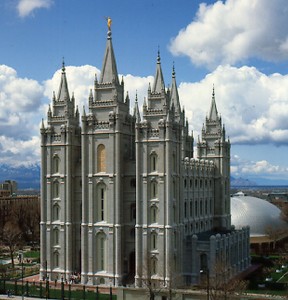
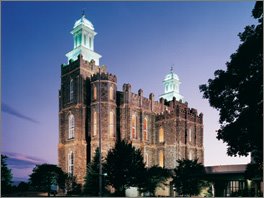 First, I want to discuss the question, “How do we learn at the temple?” God has always used symbolism to teach his children. For instance, Jesus taught in parables (symbolic stories), partly so that a wide range of people who were all at different stages of learning and understanding could be taught at once. This is no different in the temple. Virtually all teaching in the temple is accomplished in a symbolic way. For instance, have you ever wondered why the LDS temples are usually set on a hill, where they can be viewed easily, and are lit up at night? This is a symbol of the light of the Gospel that will eventually fill the whole earth. Or why is there a gold statute of an angel sounding a trumpet on the highest spire? This is a symbol that the Gospel of Jesus Christ has once more been restored to the earth and will be sounded to all nations. Or how about the exterior of the Salt Lake temple? On the lower level there are stars, the next level the moon and higher yet, the sun. This symbolizes the kingdoms of heaven, but also how we acquire more light and truth as we progress. These are three small examples of things we can learn from the outside of the temple.
 To learn effectively in the temple one needs to come to the temple in humility, being willing to be taught. We attend the temple as often as we can, because each time we are able to understand better what God is trying to teach us. In essence, the way we learn in the temple is the same way we learn in life, step by step and line upon line, receiving more knowledge, as we are able to understand it.
 At this point I want to comment on why the members of our church who have attended the temple do not talk openly about what occurs in the temple. First, these places and what takes place in them is sacred and there is no reason to flaunt before the world that which is sacred. I doubt that Moses said everything that he learned on Mount Sinai. After all, he was up there for forty days, certainly all he learned wasn’t the Ten Commandments. I know that many are curious about what takes place here, but mere curiosity and interest does not qualify a person for receiving this knowledge from God. God imparts knowledge only when we are ready to receive it. Thus, we hold things back and shield them from the world. Not because we are ashamed of them, but because our knowledge is sacred. I will say though, that nothing occurs that would be offensive to anyone.
 I do wish to inform you that before a temple of the LDS church is dedicated for use, it is opened to the public for tours—anyone, including those not of our faith can walk through on a guided tour. If there is one in your area being constructed, please take this opportunity to go on a tour, to see and feel for yourself the grandeur and awesomeness (proper usage of the word) of these buildings. Here is a
  A former prophet of the church, President Gordon B. Hinckley, also remarked on this topic when he said, “The Lord has made us attractive one to another for a great purpose. But this very attraction becomes as a powder keg unless it is kept under control. . . . It is for this reason that the Church counsels against early dating” (read the amazing talk in its entirety
  der inspiration from God. Their reasons for doing this are given in the above two statements. I see the whole thing as similar to the age requirement to be baptized. You have to be at least 8-years-old to be baptized and, while there doesn’t seem to be anything particularly special about the age of 8, Heavenly Father knew that setting that age as the standard would be in our best interest.
 About this time of year, many people get excited about the new year. A new year can be a new beginning and an excellent point to check life’s milestones, past goals and access one’s personal situation in life. It doesn’t necessarily take a new year to do this, but it seems like a good time to start anew. Coming up on this new year, I have heard and listened to a few people talk about their resolutions and others (at church, for example) speak about how best to go about fulfilling those resolutions because, let’s face it, everyone has had goals that were never completed and that were eventually discarded. This year, I’m thinking about a new approach.
 There are a few reasons for this, and I’d like to address one in particular. I have found in my own life, that even though my desire to improve is pure and my resolve strong, there are weaknesses because I am not thorough enough and there is usually something else in which I allow myself indulgence. How can I receive full strength from the Lord in breaking a bad habit when I