Do Mormons Believe in the Trinity?
A core belief of all Christians is the testimony of Jesus Christ as divine. The nature of the godhead — God the Father, Jesus Christ the Son and the Holy Ghost — is a key topic in religious discussion, and has been debated for centuries. The traditional Christian view describes the godhead, or trinity, as united in substance and in person in a way that is incomprehensible by man. As Latter-day Saints we believe as all Christians do “in God, the Eternal Father, and in His Son, Jesus Christ, and in the Holy Ghost” (Articles of Faith 1). We believe that they are one in purpose and mission and that they are three separate divine beings.
A brief study of history will show that the idea of numerical separateness of the godhead is not new, and was believed by many early Christians. For example, Arius, founder of Arianism, was ruled a heretic after the first council of Nicea for preaching, among other controversial doctrines, the separateness of God the Father and Jesus Christ.
There are many biblical passages which clearly show the separateness in person of God the Father and Jesus Christ (see Matthew 3:16-17, Luke 22:42, Acts 7:55-56). However, there are many others which also state that they are one (see Deuteronomy 6:4, John 10:30, 1 John 5:7). This dichotomy has long been recognized, and the First Council of Nicaea was convened in AD 325 to, among other reasons, set forth in formal creed the official view of the church. The famous Nicene creed, which was adopted at that council and continues today as a cornerstone statement of many current doctrines of the trinity, describes Jesus Christ as “God from God, Light from Light, true God from true God, begotten, not made, one in Being with the Father” (The Nicene Creed).
The convening of councils for the construction of creeds has been the method used by “traditional” Christian churches to resolve doctrinal disputes. As Latter-day Saints we believe that there is a better way: through revelation given directly to authorized prophets, God has revealed and continues to reveal many gospel truths. Among the doctrines made clear in modern times by revelation is the nature of the godhead as three beings, united in purpose and separate in person. We value the inspired words in the Bible, and we believe that the same spirit which inspired its writers still inspires holy men today to teach doctrines that are equally true and valuable.
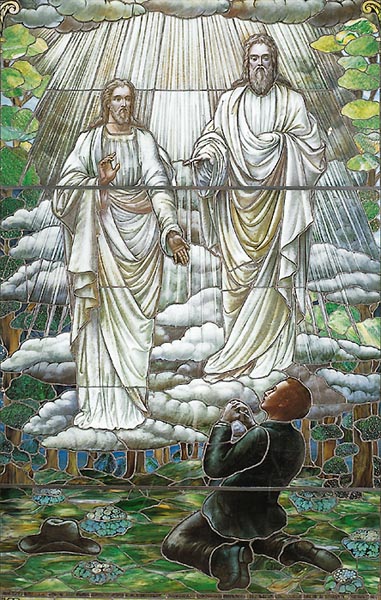
It might be said that the doctrine of the trinity is the very first of all doctrines in which Latter-day Saint teachings differ from the traditional Christian view. The first prophet called of God in modern times was Joseph Smith. When he was a boy, disputes among churches prompted him to ask God for himself which church preached the eternal truth about God and salvation. In answer, God the Father and Jesus Christ appeared to him in glorious vision. God the Father himself said to Joseph “This is My Beloved Son. Hear Him!” (Joseph Smith – History 1:17). What better example can there be of the unity of the Father and the Son as separate beings?
As stated earlier, Biblical evidence for the LDS doctrine is abundant. I have not focused on them so as to emphasize that we do not base our belief on a creed made by scholars concerning an expert interpretation of the Bible. We base our belief on the testimony given to us by the Holy Ghost that the first vision of Joseph Smith was real and prophets continue to reveal truth about God. I strongly recommend that any reader who wishes to see strong Biblical evidence of our belief read this talk (or watch it) by an apostle and special witness of Jesus Christ. I invite anybody who wishes to discover the truth of our message to study the scriptures, pray and ask God, who will tell you by the Holy Ghost that it is true.
This article was written by guest author Stephen Stacey


Very nice.
So do you think the trinity shield does NOT represent the teachings of Mormonism regarding the Godhead? (I think it does NOT).
I much prefer the picture of the First Vision as a representation.
Two points –
1) The ‘councils’ here dismissed were convened because, according to the church at the time, they had the divinely bestowed authority to seek the guidance of the Holy Spirit on questions of this nature; thus, they believed the creeds were inspired. This is not terribly unlike what we describe the First Presidency and Council of the Twelve. Setting up a simple dichotomy is an oversimplification; the ‘better way’ here described is not unlike how the early church leaders understood what they did. The Catholic Church states that the will of the ecumenical councils represents the convened mind of the Church guided by the Holy Ghost.
2) I would not so easily dismiss the role of unity in divinity. After all, out own theology teaches that exaltation only comes through sealed relationships – something more metaphysically actual than simply ‘in purpose’ – and LDS thinkers like Blake Ostler have made the case that the members of the Godhead are God in part because they participate in a common relationship that metaphysically transcends anything we can immagine.
Eric,
Thanks for your comment. I should have clarified: The trinity shield does not accurately represent our belief of the Godhead.
Eric,
Sorry for the double comment, but I should clarify further. We don’t use the trinity shield in any way to describe our view of the Godhead, and probably most Latter-day Saints would not recognize it at all. With the right twist you might be able to fit it into LDS doctrine, but it would be a stretch.
I am glad to hear you say that. I think there are some LDS who are trying to make the church sound more evangelical like than it is.
Like this post here
Matt,
You bring up some interesting thoughts. Firstly, about the councils: I believe that this argument is really indefensible. With any group claiming a divine authority, detractors will contend that such is simply not the case, and can be true in a contemporary setting just as much as in the time of the councils. Indeed, this same tension may be just as old as history itself. Perhaps it is the nature of the claim, tending to be subjective and limited to few people, which lends itself to this problem. Others looking through their own goggles at the history may contend that such councils were convened to unify an empire under one political head and to do so to avoid an otherwise crumbling and dissident people. Really, I think that both arguments are indefensible (and therefore, probably not worth arguing unless a consensus could be had).
Also the claim to having divine authority and guidance does not, of necessity, equal actual divine authority and holy guidance.
Secondly, the statement you made regarding the “metaphysically actual” seems confusing. Do you mean to say that ‘sealing’, according to Mormon theology, is something both abstract and actual, or something transcending reality but being reality? I would like some clarification on this point.
Further, that the members of the Godhead enjoy a common relationship which “metaphysically transcends [maybe redundant?] anything we can imagine”: if this statement means what I think it means, it does not seem to be a blending of identity (or loss of ‘separate’-ness) for the Mormons. Though Mormons claim a different view of such relationships (physically) between the Father, Son, and Holy Ghost than the traditional view, we do not claim to have a perfect knowledge about how God (any of them) operates completely, and that such a statement by Mr. Ostler is a dogmatic way of stating “we don’t know”.
Cheers.
Eric, you really misunderstood what I was trying to accomplish with that post of mine, “The Mormon Trinity”.
I was NOT “trying to make the church sound more evangelical like than it is.” I simply had an empathetic insight into how that diagram CAN apply in some ways to our Godhead–three separate Gods, yet “one God” (as our own scriptures assert), or Godhead.
(If there were individual circles on each of the corners of that triangle, perhaps that would even be better for our purposes, since we believe, after all, that each of the three divine persons are actually three separate beings.)
I invite you to read my most recent thoughts on the Trinity, the Godhead, Their “oneness” and our “oneness” with Them. I doubt you’ll find anything to disagree with:
“That They May Be One As We Are One”
http://latterdayspence.blogspot.com/2009/05/that-they-may-be-one-as-we-are-one.html
I have questions. The Godhead is an idea that I have not grasped fully despite being a member for about a year. I understand the concept of the trinity and that the concept of the godhead is different from the trinity. I understand that Heavenly Father, Jesus, and the Holy Ghost are three different persons. But I’m not sure how they are “united in purpose.” How does that work? Can you explain it in a way that relate it to how we as humans function? How do they know what the other members of the Godhead are thinking? Do they all get together and say “here’s the plan and this is how we’re going to execute it”? Or is the plan the Plan of Salvation and all three members automatically know how to make it work? I suppose with ‘perfect knowledge’ the three members could know things in a way that is different and not comparable to how we know things. Help?
Sunlize,
Good to hear from you again! I hope everything has been well with you!
So I’ve often heard the godhead being compared to a bishopric, or the first presidency. I’m not sure how far you can take that analogy, but in the “unitedness” aspect I think it’s good. Also, in the scriptures, it does seem to me like the Father is “more in charge” than the other two. Again, not sure how far you can take that. Maybe similar?
I’ve always understood the oneness of the Godhead in terms of the alternative, which is polytheism. Occasionally my trinitarian Christian friends will tell me that our belief in three separate beings in the godhead implies that we are polytheistic. I think the point of God’s stressing that he is “one God” is to point out the fundamental difference there.
The Jews were the first known religion to worship only one God, which is very much what set them apart from the rest of the world. Consider the Greeks, or the Egyptians. They had a God of the sun, a God of the moon, a God of fertility, a God that controlled the water, a God that managed death, a God for harvests, for getting drunk, for healing, etc. Every God did something different. They had different purposes, really. Sometimes they even fought with each other. Those people truly worshiped multiple gods.
I’ve always thought of the stressing that our God is “one God” to be a setting apart from the predominant religions of the time. Because there is obviously something more “one” about the Father, the Son, and the Holy Ghost than, say, the Gods of the Egyptians.
I can’t even begin to fathom all the ways that the Father and Son are “one”. I know they’re not “ontologically” one, but they’re infinitely more one in terms of relationship, unity, and love, etc. I really like the way Blake Ostler put it on another blog in which we were conversing with some evangelical critics. He wrote:
“Just for the record, I assert that both the Father and the Son are eternally divine. However, there is a priority of the Father in the sense that the Father offers his love to the Son, and in each moment of eternity the Son has freely chosen to fully return that love. They both offer their love to the Holy Ghost and the HG has freely chosen in each moment of eternity to return that love. It is in virtue of this loving interpenetration of freely cooperating wills that these three are one God and also have been eternally one God. Now they are inviting us into this same relationship.”
I think that one thing we often forget is that singular nouns are often used to describe plural things or people which are united in purpose; for instance, congress. We all know that there is more than one person in congress, but we refer to this body of men and women as congress.
I find that the scriptures often, but not all the time, refer to to God the Father, Jesus Christ, and the Holy Ghost in this way.
Also, just an interesting factoid:
The scripture cited in 1 John 5:7-8 which reads:
5:7 “For there are three that bear record in heaven, the Father, the Word, and the Holy Ghost: and these three are one.
5:8 And there are three that bear witness in earth, the Spirit, and the water, and the blood: and these three agree in one.”
Is called the Comma Johanneum. It wasn’t part of the original 1 John; it was added into a few manuscripts during the late middle ages.
Dave, even if scribes felt like they needed to things in to solidify their views (as Bart Ehrman has taught that they did), it doesn’t make a lick of difference to me. I still see no need to believe the only way to understand God’s oneness is to understand God is ontologically one. There are more ways to understand “oneness” than ontologically or numerically. Many Christians read their own assumptions into the text, but the text itself does not state what they think it states.
As I said on the post I provided a link to above, “Christ prayed in John 17:11 for His disciples “so that they may be one as we are one” (New International Version). The King James version says “that they may be one, as we are.” The New Living Translation puts it like this: “united just as we are”. Obviously, this is not inferring that we are all supposed to become one substance or being–but one in terms of relationship, unity, and love. This is more in line with how I view the unity of the Godhead. Jesus wants us to be one with Him and Father, just as He and His Father are one.”
In the first sentence above I left out the word “add”. Scribes added things into the biblical manuscripts. That’s just historical fact. But it still doesn’t make any difference.
See “Bart Ehrman: “Misquoting Jesus: Scribes Who Altered Scripture and Readers Who May Never Know”
http://latterdayspence.blogspot.com/2009/04/bart-ehrman-misquoting-jesus-scribes.html
Clean,
I don’t know if you thought my last post was in response to your conversation, but it wasn’t meant to counter anything you’ve said. Just an interesting fact. Carry on.
I didn’t Dave. I agreed that it was an interesting fact, and I was just piggy-backing on your comment. Thanks.
In other words, even adding into the manuscripts that God is “one” doesn’t have to mean that God is ontologically or numerically one. That’s why it doesn’t matter to me if 100 such references were added–still doesn’t change anything. Their oneness comes in the unity of the three divine persons in the Godhead.
Dave – Yes, I’m still here.
Sometimes I get buried under school stuff and life, and then I have less time to read and post on blogs. And somehow I missed that you guys changed domains so my google reader wasn’t updating anymore.
Anyhow, I think the difference between the godhead and polytheism can be seen in how we pray. When I pray I may be directing it to one part of the Godhead but all three members are able to hear and answer my prayer. For example, I pray to Heavenly Father (“Dear Heavenly Father…”) but I do so in the name of Jesus Christ (“in the name of Jesus Christ, amen). And then during and after the prayer I rely on the Holy Ghost to give me answers and/or direction.
If a polytheist prays to Athena, he does not expect Aphrodite or Zeus to hear or answer his prayer.
Does that make sense?
Hey guys, one thing is true: The Trinity will always be a mystery and there is no shame in that.
However, trying to poke holes in factual church history and biblical writings is comical when there are a slew more inaccuaracies in the chruch of LDS. A non-morman (or former mormans) could easily poke fun at the notion that the core beliefs of the chrich of LDS come from a hokey “an angel came to me” bit by Mr. Joe Smith, a “political” figure mind you.
The “Trinity” preserves the facts Jesus revealed about God.
The basic fact is Jesus himself and what he said. Jesus was once asked what was the greatest commandment and he said, “Hear, O Israel, the Lord our God, the Lord is one. Love the Lord your God with all your heart and with all your soul and with all your mind and with all your strength.” (Mark 12:29) In other words, Jesus affirmed that there is one God but he also said, “I and the Father are One” (John 10:30) and accepted the worship of his disciples (Matthew 2:11; 14:33; 28:9; 28:17; John 9:38). He said, “He who has seen me has seen the Father” (John 14:9. )He said, “When the Counselor comes, whom I will send to you from the Father, the Spirit of truth who goes out from the Father, he will testify about me.” (John 15:26)
When you put together all Jesus’ teaching about God and try to express it, you come up with the Trinity — Father, Son and Holy Spirit – Three in One.
The trinity is critical in the Christian faith for obvious reasons. As non-christians, I can understand the Mormon confusion.
I pray everyday for non-believers. God Bless!
Well, gosh, Dan, with a “respectful” comment like that you’ve almost persuaded me to become a creedal Christian. Where do I sign up?
Actually, as an LDS Christian, I prefer a coherent theology–one that’s not self-contradicting.
Dan,
As I’m sure you already guess, we don’t consider those scriptures to be at all contrary to our beliefs. God and Jesus Christ, as you read in the article, are “one.” One in purpose and in worship from us.
The scriptures in the bible that indicate that Jesus Christ and God the Father are two separate beings are abundant. So abundant that I won’t list them here. But here is a list of 61 of them for you to read at your leisure.
It should again be emphasized again that although we see the abundance of biblical evidence pointing towards a nontrinitarian God, the main reason we reject the trinity is because God and Jesus Christ revealed themselves to Joseph Smith separately.
very interesting, but I’m a little confused. If Mormons believe that God, Jesus, & Holy Spirit are seperate but are God, does this mean that Mormons have 3 Gods? (as oposed to Christians who believe in 1 God). Also, do Mormons believe in any other Gods other than Jesus, Holy Spirit, & God?
Good question. We believe that all three members of the Godhead deserve the title “God”, so in that sense we believe in three gods. In saying this, I warn you not to fall into the trap I have seen so many others do. People who do not wish to learn will often look into something with the intention, conscious or otherwise, of finding something disagreeable so that they can justify themselves in looking no further. Please don’t allow yourself to so narrowly define what it means to believe in “one god” that you fail to see how the doctrines revealed in modern times agree so well with what the Bible teaches. I promise that every belief we teach can be reconciled with Bible teachings, and if you’ll let yourself learn of it then you can see your understanding of the Bible and about Jesus can grow by leaps and bounds. Can you do that?
Can I quote one of the entries?
“In the first sentence above I left out the word “add”. Scribes added things into the biblical manuscripts. That’s just historical fact. But it still doesn’t make any difference.
See “Bart Ehrman: “Misquoting Jesus: Scribes Who Altered Scripture and Readers Who May Never Know”
http://latterdayspence.blogspot.com/2009/04/bart-ehrman-misquoting-jesus-scribes.html”
I’m sorry- but most Christians today would reject anything that Ehrman states. There are better theologians than that to quote- who seem to disagree with Bart’s conclusions (he has a huge axe to grind that if you look long anough will find and will enlighten the discussion). If you were to come to my house and start quoting from Mr Ehrman I would laugh you out of the building. Really. He is that bad. So bad in fact that you wouldn’t ever reach the point of talking about your own faith to me. It would be an affront to my own beliefs. I have friends who read Ehrman so that they can know what he is saying, but most won’t entertain him at all.
I know that some see the Johannine portion of I John as an ‘addition’ by ‘redactors’, but the history does not *necessarily* prove that is the case. Theologians from both liberal and other camps tend to agree to disagree on this. It matters not. As a Christian seriously looking at the LDS faith with a view to moving over to it I see the argument against a traditional ‘trinity’ as a straw man. It would be better to focus on the existence of a relationship between the members of what we call the ‘Godhead’. One theologian I know calls this the principle of ‘the God who is never alone’. I prefer that.
The important question for a Christian (and by that I mean a non-LDS Christian) is whether a group professing Christian belief declares Jesus to be God. It is here you will often find a battlefield. An example of Christian theology on this subject far more reliable than Ehrman is Robert M Bowman’s “Putting Jesus in His Place”, a fine example of critical and historical thinking on the deity of Christ. On the trinity you will find many views- from orthodox to evangelical. Most all agree that God is ‘One’ in trinity. How’s that for clear
To me it seems your view of the Godhead is clearer than most, and if I were you I would be using that to help people understand the God who is never alone, rather than some wacky theologian who professes a Christian faith but is mostly accepted by those outside of the Christian faith
Sorry if I offended anyone there
Paul
Not at all, Paul. No offense taken. I’ve never read anything of Ehrman’s, but I appreciate your warning and I might have to take a look at Bowman.
It’s tantalizing to jump into the fracas and argue the nature of God from the trinitarian worldview, but we Mormons need to remember that our conception of God comes not from theological debate. It was revealed to a prophet.
And I agree with you, Paul. Our view of the Godhead is exceptionally clear.